
back
Argentium Project
Argentium 2005
Argentium Gallery
contact
home
|
The Argentium© Project: Developing New Avenues for Silver Design
Summary of Project Proposal
The aim of this project was to develop new avenues for contemporary silver design in the light of new opportunities arising from the combined use of Argentium Sterling Silver (AS) and laser welding. AS is a new silver alloy, which contains a small amount of Germanium, and which has some enhanced properties compared to traditional Sterling silver
and which is advantageous in the use of laser welding.
This project arose from an initial exploration by Niedderer (Niedderer, Harrison, and Johns 2006), which tested the performance of AS in the complex context of practice, and which suggested that the combined use of AS with new technologies could offer potential for new developments in silver design. One such technology is laser welding, which can be used successfully with AS but not with SS due to differences in the material properties.
The benefit of laser welding is in minimal heat application, which allows the use of thin, flexible, work-hardened material. In contrast, the traditional use of soldering requires heating the whole piece during fabrication which softens the silver. Any design using soldering processes therefore has to use sheet material of sufficient thickness to avoid easy indentation within use, commonly ranging between 0.8 - 1.5 mm. This makes silverware expensive and puts a range of constraints on the designing and making of silverware. Because of the softness of the material, pieces made of thinner material may e.g. distort during heating; need to be work hardened after the last soldering stage; or need to be filled with supporting material (pitch).
This project therefore investigated the combined use of AS and laser welding for developing new avenues in silver design. In particular, the focus was on the use of thin, hard rolled sheet material using laser welding in designing hollowware. The research was conducted through the use of creative practice set within a robust theoretical framework. The framework was developed from a comparison of the characteristics of representative examples of silver design, which were selected and analysed according to criteria of technological, conceptual, and aesthetic developments. The comparison of the different characteristics established a framework for what may count as 'contemporary' and 'advance',
and thus as 'new avenues', as guidance for the practical inquiry.
The practical inquiry explored the relationship of fabrication methods, and of aesthetic and conceptual expression. Creative practice was used to identify and explore different ways of joining AS through laser welding and to analyse the aesthetic results and expression. The results were compared with the insights gained from the theoretical inquiry in order to develop ideas and suggestions for new avenues in silver design. A number of ideas were realised to test and demonstrate both process and results. The project was concluded with an evaluation of the outcomes of the practice phase against the criteria developed in the framework.
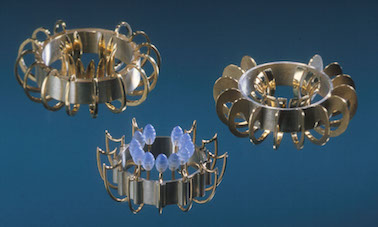
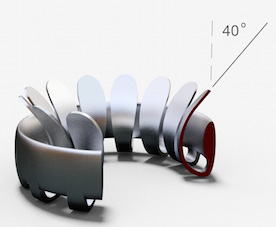
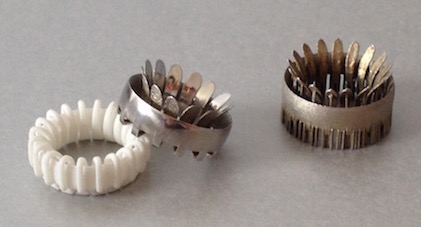
The outcomes of the project comprises the definition of the notion of 'new avenues', a set of defining criteria to provide a guiding framework for developing new avenues, and the production of examples of developing new avenues for silver design through the combined use of AS and laser welding. The outcomes have been published through conference and journal papers, and through exhibition of the practice work, including research process, designs, and contextual materials, at Birmingham Museum and Art Gallery.
|